

1 April 2026
By: Paula van der Werff and Evelien Janson
Subconscious patterns behind inner unrest
This article is part of a series in which, together with
Each article focuses on a specific target group and shows how change at the subconscious level can create space for sustainable development.
This article was written in collaboration with Evelien Janson, who works with conscious and driven professionals aged 50+.
Successful… but does it still feel like your life?
She sat across from Evelien and said something many professionals in this phase of life recognize:
“Actually, things are going quite well. I can’t complain.”
A good job. Financial stability. A network. Years of carrying responsibility and meeting expectations. From the outside, there seems little reason for doubt.
And yet, something else can be felt. Not a clear crisis, but a subtle inner tension. A sense that more is possible than what is currently being expressed. As if life has largely been built from responsibility and loyalty, rather than from a conscious choice for what truly fits.
Many professionals over 50 do not immediately recognize this as a problem. They describe it more as a form of inner unrest, a diminishing sense of freedom, or a quiet suspicion that their life no longer fully aligns with who they have become.
What outsiders call stability can internally be experienced as a constant state of alertness.
The invisible influence of loyalty
Many of the professionals Evelien meets in her practice appear to have their lives well organized. They are responsible, committed, and reliable. In both their careers and personal lives, they have learned to be strong, to take responsibility, and to keep going when needed.
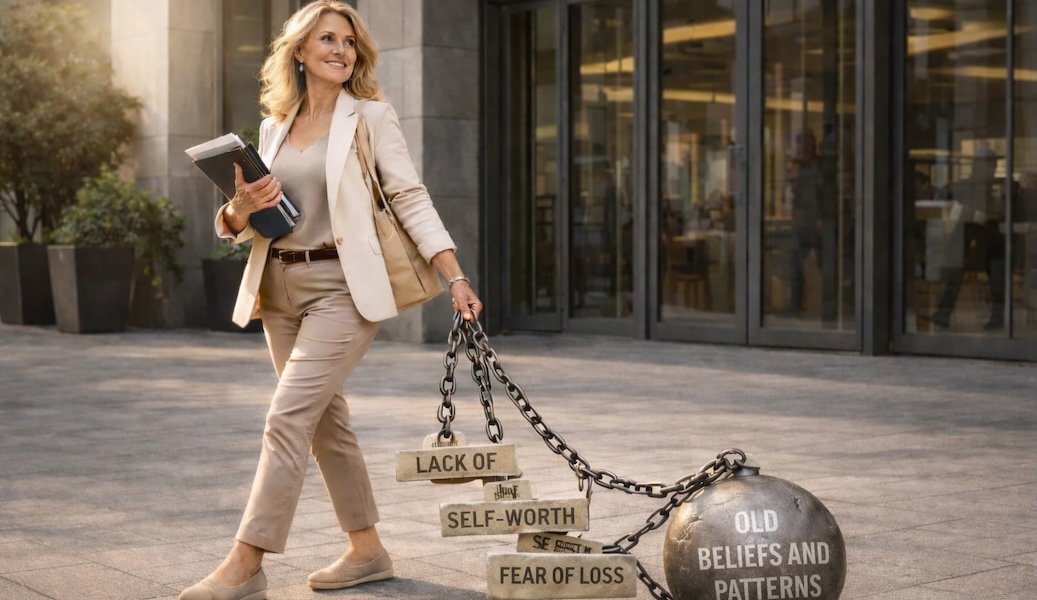
Beneath that strength often lies a set of beliefs formed earlier in life, such as:
- I have to be strong.
- I have to keep going.
- I must not burden others.
These beliefs are rarely consciously chosen. They are often formed in situations where responsibility or adaptation was necessary. In some cases, they originated in families where stability was not guaranteed; in others, during periods where performance or caring for others was central.
For the woman Evelien worked with, a family member with alcohol addiction played an important role. During that time, she had learned to stay constantly alert, maintain harmony, and carry responsibility. Her subconscious system had linked these strategies to safety.
What was once functional continued to operate automatically, even years later.
When the body gives the signal
During a
Cognitively, she had long understood her patterns. She knew she had carried a great deal of responsibility and that loyalty played a major role in her choices. But during this process, she experienced a physical shift for the first time. Her body seemed to remember what relaxation actually feels like.
After several balances, she noticed that not only did her inner tension decrease, but a persistent shoulder injury she had struggled with for a long time also began to respond better to physiotherapy. Treatment became more effective than before. What had held tension for years gradually began to move.
Experiences like this illustrate how closely mental and physical processes can be connected when subconscious beliefs change.
Why insight alone is often not enough
Many professionals over 50 have already come a long way in personal development. They have read, reflected, and sometimes undergone therapy. They often understand where certain patterns originate.
Yet insight alone is rarely enough to truly change deeply rooted patterns.
As long as a belief in the subconscious remains linked to safety, the system tends to repeat the same behavior. The cognitive mind may want to make different choices, but the body often follows the old programming.
This is precisely where PSYCH-K® operates. The method focuses on changing limiting beliefs at the subconscious level. When beliefs connected to safety shift, the internal frame of reference from which choices are made also changes.
A small shift, a noticeable impact
Sometimes a relatively small inner shift can have a large effect. When the belief shifts from:
- I have to meet expectations
to
- I am allowed to choose
the way someone experiences themselves and their life changes.
Professionals often describe that boundaries become clearer, choices feel easier, and relationships become more honest. The pressure to constantly meet expectations decreases, while the sense of autonomy and inner calm increases.
Life itself does not have to change drastically. Often, it is the inner position from which someone shapes their life that shifts.
A personal turning point
Evelien recognizes this process from her own life. For a long time, she functioned well within the expectations of work and her environment, while also feeling that more was possible.
The turning point came when several people around her became seriously ill around retirement age. She saw how long-term tension, limiting beliefs, and unhealthy patterns could take their toll.
That moment raised a fundamental question: what does it mean to truly live in alignment with who you are?
Through
For those who recognize this
If you are over 50+ and, despite success, notice a subtle inner unrest, this does not have to be a sign of weakness. It may actually be a signal that a new phase of development is emerging.
What once functioned well, such as pushing through, being strong, or staying responsible, may later require recalibration. Not by working harder on yourself, but by exploring which subconscious beliefs are still influencing your choices.
Ultimately, the question is not whether your life is good enough.
The question is whether it still aligns with who you truly are.
Autonomy and guidance
At De Werff, we train people in
Our
At the same time, individual guidance can be valuable when patterns are deeply rooted or when someone seeks additional depth. The Facilitators within De Werff’s quality network work from the same vision: support is aimed at strengthening self-regulation, not creating dependency.
Autonomy and guidance do not exclude each other. They reinforce one another.
Werff Letter
Would you like to receive the monthly newsletter? Sign up to read stories with

